SOCAutomation
SOCAutomation Architecture Overview
SOCAutomation processes security information through a controlled sequence of ingest, analysis, contextual reasoning and response. The architecture is designed to accept diverse data, maintain operational context and support automation at the level of governance appropriate to each organisation.
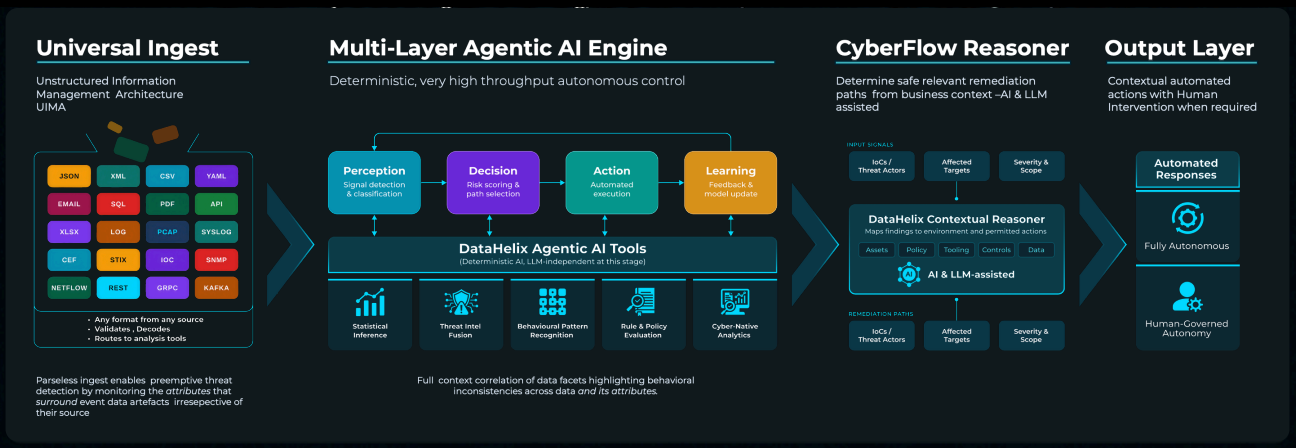
Architecture at a Glance
Information moves through four connected layers. Universal Ingest accepts and prepares data; the Multi-Layer Agentic AI Engine detects, assesses and correlates security signals; CyberFlow applies environmental and business context; and the Output Layer delivers an automated or human-governed response.
1. Universal Ingest
Accepts structured, semi-structured and unstructured information from diverse security and business sources.
2. Multi-Layer Agentic AI Engine
Uses deterministic, high-throughput security analytics to detect signals, assess risk and select an appropriate processing path.
3. CyberFlow Reasoner
Maps findings to the organisation's assets, policies, tooling, controls and available response options.
4. Output Layer
Executes permitted responses automatically or presents them for human review and control.
Universal Ingest
The ingest layer is based on an unstructured information management architecture. It accepts information in common event, log, document, API and threat-intelligence formats without requiring every source to be reduced to a rigid, source-specific parser before analysis can begin.
Format and source independence
The platform can receive data from security products, cloud services, applications, files, APIs and messaging systems. Supported examples include JSON, XML, CSV, YAML, email, SQL, PDF, XLSX, logs, PCAP, Syslog, CEF, STIX, IOCs, SNMP, NetFlow, REST, gRPC and Kafka.
Validation, decoding and routing
Incoming information is validated, decoded and routed to the relevant analytical tools. Attributes surrounding an event or data artifact remain available, allowing relationships and behavioural inconsistencies to be identified across sources.
Multi-Layer Agentic AI Engine
At the core of SOCAutomation is the DataHelix Agentic AI engine. It operates as a continuous perception, decision, action and learning cycle, supported by deterministic security analytics designed for predictable, high-throughput processing.
Perception
Detects and classifies signals within the incoming information.
Decision
Scores risk and selects the most relevant analytical or operational path.
Action
Executes the automated processing required by the selected path.
Learning
Uses feedback to refine models and improve subsequent assessment.
The engine combines statistical inference, threat-intelligence fusion, behavioural pattern recognition, rule and policy evaluation, and cyber-native analytics. These tools correlate multiple facets of the available data and highlight inconsistencies that may not be visible when sources are assessed independently.
CyberFlow Contextual Reasoning
Analytical findings are passed to the CyberFlow reasoning layer. This layer considers the indicators and threat actors involved, affected targets, severity and scope, then maps those findings to the organisation's actual operating environment.
Environmental context
Relevant assets, policies, available tooling, security controls and supporting data are considered before a response path is selected.
Permitted remediation
AI and LLM-assisted reasoning can be applied where it adds value, helping determine a safe and relevant remediation path that remains within the actions permitted by the organisation's configuration and policy.
Output Layer
The Output Layer converts the selected response path into an operational action. Depending on policy, risk, confidence and the available integrations, SOCAutomation can execute a response autonomously or place the action under human governance.
Automated responses
Approved, well-understood actions can be executed without manual intervention when the organisation's policy allows full autonomy.
Human-governed autonomy
Higher-risk or less certain actions can be reviewed, approved or directed by an analyst before execution.
Operating Principles
SOCAutomation uses deterministic processing where consistency and throughput are essential, and applies AI-assisted reasoning where context and interpretation improve the decision. The result is an end-to-end operating model that retains policy control while reducing integration overhead, accelerating investigation and supporting response at scale.
Video walkthrough placeholder
Add an embedded architecture walkthrough by inserting an <iframe> or <video> element and applying the is-visible class to this container.